Blog Feed

Featured

Introduction to Bakke

TIME Magazine cover which addresses the stakes of Bakke and the contradictory nature of the decision. The image depicts a percent sign and in one of the circles there is a smiling white man and in the other there is a frowning Black man. The text on one side reads: Quotas no and on the other it read: Race yes.

Regents of UC v Bakke was a landmark case decided by the Supreme Court of the United States regarding race-based college admissions and affirmative action. The decision upheld affirmative action, but struck down racial quotas, which were pivotal to the diversification of higher education spaces. These racial quotas set aside certain percentages of their spots available for admitted students for students that held certain racial identities and had suffered systemic inequality.

This case was an opportunity for the court to address the way race-based college admission was a critical liberatory project that embodied a specific kind of reparation. While the decision upheld the practice of considering race in the admissions process, it limited the amount of recourse that could be offered by higher learning institutions. This case represents the way that managing difference is tied up in legal struggles that fail to provide recourse or recognize histories and legacies of violence and exclusion. This court case had the possibility of declaring the issue of affirmative action, as a form of reparation, a critical space in which societal and systemic inequality would not be tolerated, and that the impact and intention of affirmative action was a way to do this. However, the court’s decision failed to do this, and in turn, failed to comment

The University as a non-neutral space

Comic with 6 colored panels that show the oval office, a man crying in an office space, a university, a court room, and a graduation stage with a white man, Bakke, in cap and gown.

As food for thought, I would like to offer a critique of university spaces, which are not neutral in this issue. While of course, in this example, the university was fighting for diversity and inclusion, it is important to note that the university is a product of mass American institutions, like those of incarceration. That being said, it is important to be aware of the way inclusion is a benefit to the institution itself, and the way power is being used and remolded to maintain its leverage throughout changing times. Histories of inclusion have prompted institutional reframing that shifts power, but never gives it away. So, while this case did not provide recourse for those who needed it and who have suffered at the hands of violence and complacency alike, the university also needs to distribute resources and access to communities that need it. I wonder how the university, because of their stake in this case, is also complacent in not addressing histories and legacies of managing difference, perpetuation violence and deploying technologies of exclusion.

Analysis

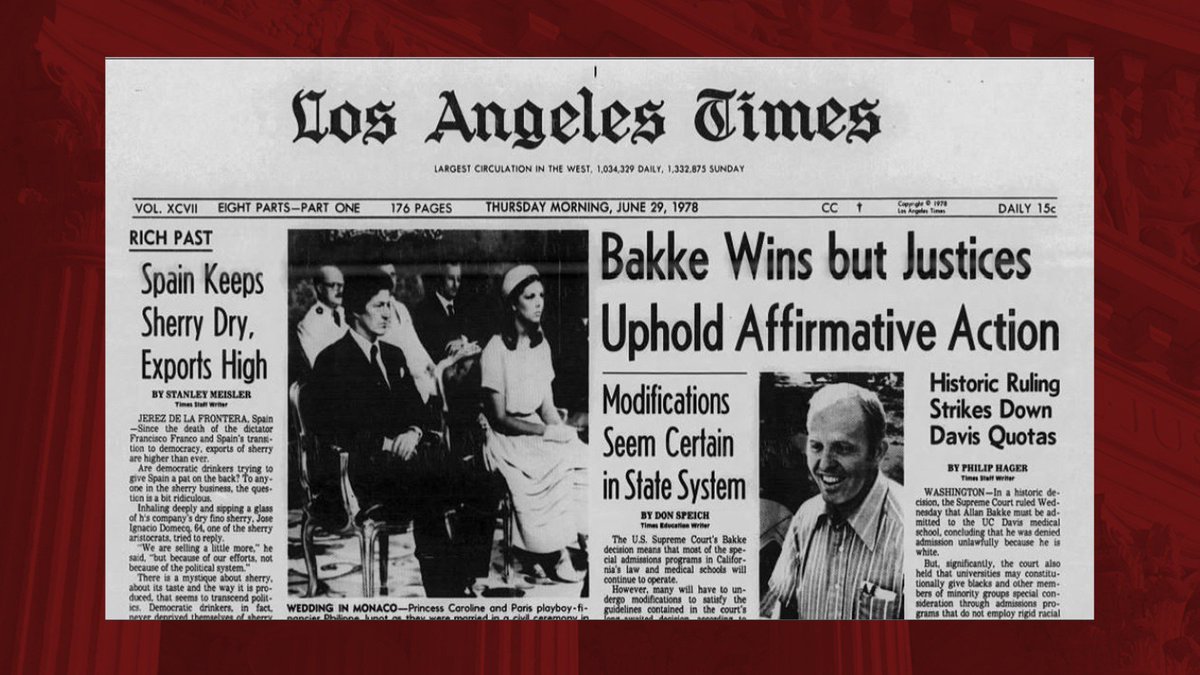
A black and white Los Angeles Time newspaper page that has a headline that states, “Bakke Wins but Justices Uphold Affirmative Action”

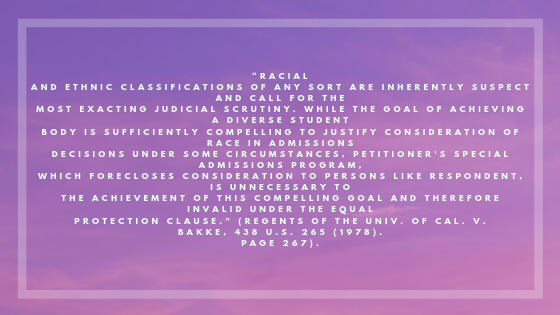
This excerpt from the legal opinion exemplifies the way the court haphazardly addressed the issue of race. The court did not make a bold statement rejecting the politics of anxiety that permeated this discourse. The fact that racial and ethnic classifications were labeled as inherently suspect exemplifies the vacuum in which this case was discussed and the way it did, in fact, take a stance on the issue, by circumventing the potential transformative decision that could have been made through their ruling. The use of the word “unnecessary” to portray the goal of higher education and its widespread impacts regarding the betterment of society. Of course, this case is not merely about a college acceptance letter- it is also, and most importantly, about access to wealth, access to upward mobility, access to rise from poverty, access in many forms that are critical to building a just and equitable society. So, it is important to be critical of the way language was used to nitpick and define narrowly in a way that escaped the ethos and scope of this decision and what it represented.

Analysis

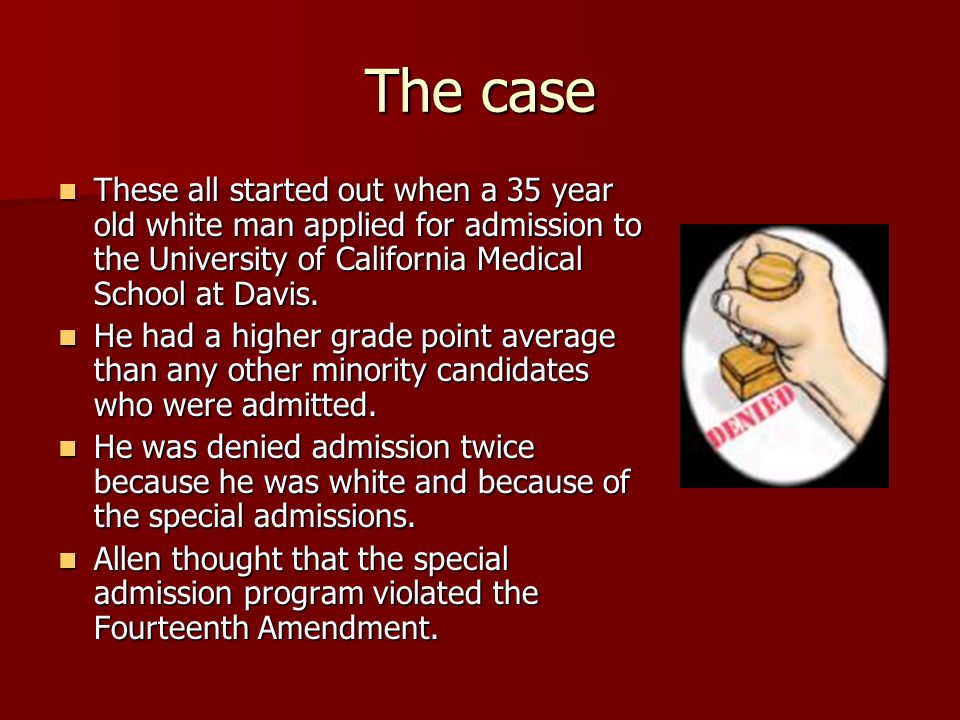
A red image with white letters in bullet point format. There is an image if a hand with a stamp in it that has stamped the word “denied” onto a piece of paper. The text contains the background information for the case of Bakke.

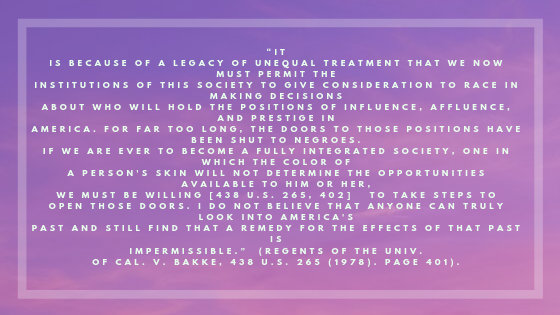
This argument relies on the futuristic projection of a world in which “the color of a person’s skin will not determine the opportunities available to him or her…” but it also acknowledges that recourse is needed before such a reality can become plausible. This opinion’s acknowledgement of the past- and of the limited impact recourse (up until that point) had had- indicates the work that must be done, in this case, to promote access and reject the perpetuation of inequity that Bakke’s stake proposes. This statement refuses to state that the impact of racist legacies and histories has come to an end and that the policies set forth by UC Davis are in fact, harming. This opinion also negates the narrow view of impact that the previous example relied upon, by exemplifying the broad and widespread implications that segregation and racism have had on people of color in this country. The responsibility is placed on the court to support affirmative action and provide the legal support to disenfranchised community, so the reliance of skin color in admissions policies, for example, might no longer be needed. The equal protections clause, in comparison to the opinion above, is viewed as a vehicle through which equity is made plausible- not a limiting notion that refuses to acknowledge impact of history.

Analysis

Given the historical precedent this course is based upon, this opinion’s proximity to the notion of “equal protection” is rooted in a version of equality that is inconsistent with historically specific acts of exclusion. Of course, this is a controversial matter, and is subject to many differing readings, but the way in which the notion of equality is compulsorily paired with the rights of individuals, as opposed to groups, limits the scope of consideration in ways that exclude understandings of trends and widespread, systemic acts of managing difference and perpetuating segregation. Establishing equality as a personal right proves effective in the way it is able to fashion a narrow understanding of race, exclusion, and belonging. Of course, this case lies on the experience of Bakke, but an opinion like this one, fails to understand the way a narrow application like this might eclipse the broader understanding of the educational system’s failings in order to provide true recourse. The guarantee of equal protection is tricky, given that it does rest on the same treatment of people of different identities and from different circumstances but the issue this opinion fails to raise is the way in which equal protections does not exist in a vacuum, and in fact, must interact with the material realities that demand action. While equal protection might truly require a broad and consistent application, it must come from an understanding of the way legacies of disenfranchisement led to the need for this kind of protection.

Analysis

A black and white photograph of protesters who are holding signs in protest of the Bakke decision, which their signs say should be overturned because the ruling is racist.

The case of Regents of University of California v Bakke illuminates cultural shifts and attitudes while simultaneously addressing the court’s role in providing recourse for histories of racial violence, management, and exclusion. The language used in this case exemplifies the need for legal, social, and cultural recourse but the history of this case indicates society’s ambivalence toward race-specific, actionable methods toward equity. This case serves as a prism through which one can observe trends in the history of racial inequality of America as well as the anxieties that drove it and the beliefs that shaped it- but what does this case, read alongside the work of Crenshaw and Ferguson illuminate regarding possibilities for change and paths forward? This case was tasked with addressing admissions policies, but it also tested the limits of society’s willingness to pay for the past. How does intervention and recourse play out in this case and what do Crenshaw and Ferguson have to say about efforts like the one made in this case? How do images serve as an iconography and a vehicle of remembrance that sustains and fabulates a conversation that is riddled with innuendo and a willingness to erase and forget?

What does this case illuminate about American culture?

Black and whit comic that shows Supreme Court justices stating, in order “affirmative action is okay… as long as it’s not… too affirmative… or too active”

This case illuminates widespread cultural attitudes that are consistent with a neoliberal framework. The court’s opinion highlighted a need, but refused to uphold the method, or make a statement regarding the importance of the issue or the attempt to promote change. In addition, this legal opinion reveals cultural anxieties surrounding inclusion and the impact diversity would have on meritocracy and elitism. This court understood that the whiteness and exclusionary practices of these spaces was a force that required deconstruction, but was unable to support a method that would do so. In this case, Bakke’s rejection from the school he applied to twice seemed a more pressing issue than taking a stance on widespread racial inequity. This kind of outlook and framework for these issues set up by the court as well as by cultural attitudes, reveals the limited scope and the narrow understanding that issues of race are addressed with. It is impactful that the case of one man who was denied admission to a college of his choice superseded the supposed importance of the promotion of equality.